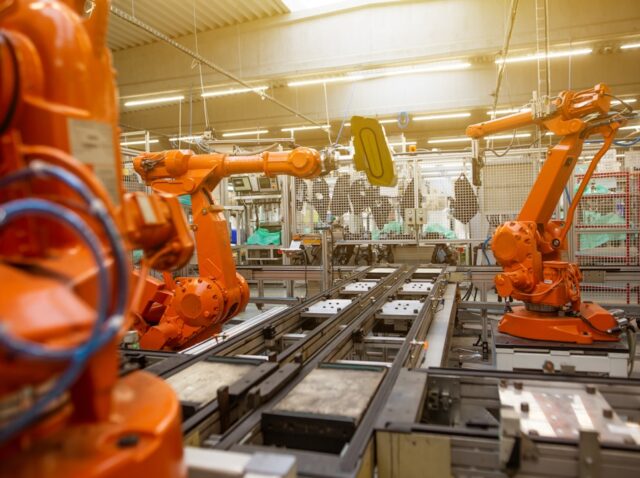
In manufacturing, the most expensive word in the English language is “Downtime.” When a production line stops because a conveyor belt snapped or a robotic arm jammed, it costs roughly $22,000 per minute in the automotive industry.
For years, we tried to solve this with IoT sensors (vibration monitors, heat sensors). But sensors are expensive to install on every single moving part.
In 2026, the industry is upgrading to “Physical AI” (Computer Vision). Instead of wiring sensors to a machine, we simply point a $50 camera at it. The AI “watches” the machine 24/7, detecting microscopic changes in movement or product quality that the human eye misses.
Here is how The AI Division is helping factories deploy “Eyes on the Floor” to eliminate unplanned downtime.
Use Case 1: Visual Anomaly Detection (Quality Control)
The old way of Quality Control (QC) involved statistical sampling: checking 1 out of every 100 widgets. If that one was bad, you had to scrap the whole batch.
The AI Way: 100% Inspection. We deploy a Visual AI Agent on the assembly line. It inspects every single unit passing by at 500 units per minute.
Surface Defects: Identifies scratches, dents, or paint bubbles.
Assembly Validation: Checks if a screw is missing or a label is crooked.
Measurements: Verifies dimensions within millimeter tolerance using standard cameras.
If a defect is spotted, the AI triggers a pneumatic arm to eject just that specific unit instantly. No batches are wasted.
Use Case 2: Predictive Maintenance (The “Health” Camera)
Machines rarely break instantly; they degrade over time. A standard camera, paired with an AI model, can “see” degradation.
Vibration Analysis via Video: The AI tracks the pixel movement of a motor. If it starts vibrating differently (indicating a bearing failure), the AI flags it.
Thermal Monitoring: Using infrared cameras, the AI detects if a gearbox is running 5°C hotter than its baseline, predicting failure weeks in advance.
The Result: Maintenance teams stop reacting to fires and start scheduling repairs during planned breaks.
The Tech: Why “Edge AI” is Mandatory
You cannot run a factory on the Cloud. If the internet cuts out, the production line cannot stop. And you cannot send 4K video streams to OpenAI’s servers—the latency is too high and the bandwidth cost is astronomical.
This is why we build on Edge AI. We deploy small, specialized models (like YOLOv10 or MobileNet) directly on small computers (like NVIDIA Jetson Orin) that sit inside the factory.
Zero Latency: Decisions happen in 10 milliseconds.
Offline Capable: Works even if the factory Wi-Fi goes down.
Data Privacy: Proprietary product designs never leave the building.
The Safety Bonus: AI PPE Detection
The same cameras used for quality can be used for safety. Our Safety Agents monitor the floor 24/7. If a worker enters a “High Hazard Zone” without a hard hat or high-visibility vest, the AI:
Sounds a local alarm.
Logs the incident for the Safety Officer.
(Optionally) Stops the machine automatically to prevent injury.
The Verdict: The Smart Factory is Finally Real
Manufacturing has always generated data, but it was “Dark Data”—video footage that was recorded but never analyzed. Physical AI turns that video into actionable insights.
Is your factory running blind? Stop relying on manual inspection.
Book a Consultation with The AI Division. We will show you how to retrofit your existing CCTV cameras into intelligent sensors.