Contacts
Follow us:
Get in Touch
Close

Contacts

Ahmedabad, India

+917574959400

info@theaidivision.com

ManagedForce: AI-Driven Multi-Agent ITSM Automation Solution

Projects

Brief and project description

Implementing a multi-agent automation layer within existing ITSM systems to help organisations achieve faster, smarter and fully autonomous service operations.

ManagedForce brings a new level of intelligence to IT Service Management. Instead of relying on traditional automation scripts, it adds an autonomous operations layer that can interpret issues, make decisions, and take action on its own. Think of it as a digital team that’s always awake, working quietly in the background and connecting seamlessly with the systems your organisation already uses, including ServiceNow, ManageEngine, TopDesk or any other ITSM platforms.

  • Seamless Integration: Works with your existing ITSM platforms without requiring major changes.
  • Swarm Intelligence: Multiple specialised agents collaborate to resolve issues faster.
  • Autonomous Resolution: Automatically analyses and closes L1 and L2 tickets end to end.
  • Contextual Reasoning: Understands issues in context rather than relying on rigid scripts.
  • 24/7 Scalability: Expands instantly to manage high ticket volumes anytime.
Let's connect

The Challenge

Our client, a multinational Financial Services Enterprise supporting a global workforce of over 10,000 employees, had hit a critical “efficiency plateau.” As their internal infrastructure scaled, hiring more support staff yielded diminishing returns. They faced three distinct operational failures that threatened their internal uptime:

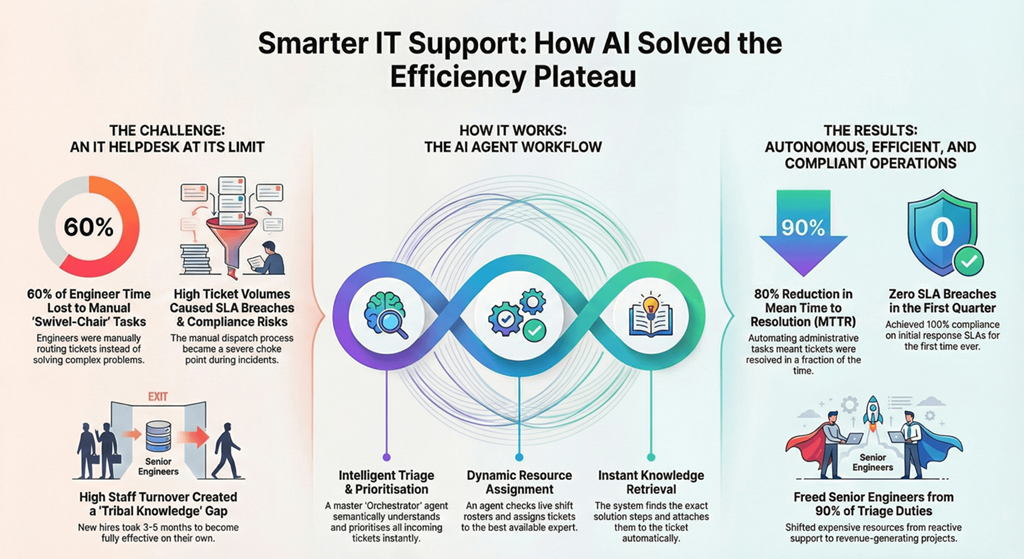
  • Operational Bottlenecks & “Swivel-Chair” Fatigue: Their internal IT Helpdesk engineers were spending 60% of their shifts acting as glorified routers. They were stuck in a cycle of “swivel-chair” tasks, manually reading a ticket, switching tabs to Excel to check consultant shift rosters, and switching again to legacy wikis to find solution steps. This context switching was killing productivity and delaying resolution for critical banking systems.

  • SLA Slippage & Compliance Risk: During high-volume incidents (such as a regional server outage or end-of-quarter reporting spikes), the manual dispatch process became a severe choke point. Tickets piled up faster than humans could assign them, leading to missed “First Response” Service Level Agreements (SLAs) and creating compliance risks for regulated data handling.

  • The “Tribal Knowledge” Gap: The IT division faced a high turnover rate. New hires took 3-6 months to ramp up, often escalating simple issues (like a specific VPN configuration error) to expensive L3 engineers simply because the solution was “tribal knowledge” known only to senior staff, rather than easily accessible documentation.

Traditional automation breaks whenever a variable changes. True resilience requires autonomous agents that can reason through ambiguity. We didn't just want to route tickets faster; we wanted to build system that understands them.

Lead Solutions Architect, The AI Division

The Solution

The AI Division re-architected their support workflow by engineering a Hub-and-Spoke Agentic System. This system is governed by a central “Orchestrator” that mimics the decision-making capabilities of a Senior Incident Manager, ensuring high accuracy and low latency.


The Workflow Breakdown

  • The Orchestrator Core (The Brain):
    We built a master agent that listens to incoming ticket streams via real-time Webhooks. Unlike a basic regex router, this agent possesses semantic understanding. It instantly differentiates between a low-priority user error (e.g., “I can’t print”) and a business-critical failure (e.g., “Core Switch 3 is down”), prioritizing the workflow accordingly.

  • Intelligent Triage & Classification Agent:
    A specialized sub-agent utilizes Natural Language Processing (NLP) to parse the technical jargon within the ticket body. It filters out noise and automatically tags the issue domain (Network, Hardware, Identity Management) and severity level. This eliminates the 15% error rate previously caused by hurried human triage.

  • Dynamic Resource Assignment Agent:
    This agent solves the scheduling nightmare. It integrates directly with the company’s Workforce Management API to analyze live shift rosters. It checks the current ticket backlog of every active consultant and assigns the new ticket to the best available expert who is currently on shift. This ensures optimal load balancing and prevents burning out specific team members.
  • Autonomous Knowledge Retrieval (RAG):
    Perhaps the most impactful feature, the Solution Agent performs a semantic search across the company’s vector-indexed Knowledge Base. It retrieves the exact resolution steps for the specific error code and posts them as a “Private Note” inside the ticket. This effectively gives a Day-1 junior engineer the knowledge of a 10-year veteran instantly.

Technology Stack

We utilized a modern, scalable stack designed for security and enterprise integration:

  • Orchestration Framework: LangChain / LangGraph

  • LLM Logic: GPT-4o (For high-level reasoning and decision making) & Fine-tuned Llama-3 (Hosted locally).

  • Memory & Retrieval: Pinecone Vector Database

  • Backend Infrastructure: Python (FastAPI)

  • Enterprise Integrations: ServiceNow REST API (Ticket management) & Microsoft Graph API (Calendar and Teams integration).

The Results

The implementation of ManagedForce fundamentally changed the operational economics of the client:

  • 80% Reduction in Mean Time to Resolution (MTTR): By automating the “administrative” side of support (categorization, assignment, research), tickets were resolved in a fraction of the time.

  • Zero SLA Breaches: For the first time in company history, the client achieved 100% compliance on initial response SLAs during the first quarter of deployment, even during peak traffic.

  • Strategic Workforce Optimization: Senior engineers were freed from 90% of triage duties. This allowed the client to shift their most expensive resources from “keeping the lights on” to revenue-generating infrastructure projects.

Reduction in MTTR
0 %
SLA Compliance
0 %