Contacts
Follow us:
Get in Touch
Close

Contacts

Ahmedabad, India

+917574959400

info@theaidivision.com

TellerSense: Cognitive AI Voice Agent for Insurance Operations

Projects

Brief and project description

Replacing rigid IVR menus with an ultra-low latency, conversational Voice AI capable of handling complex insurance claims with empathy and precision.

TellerSense is a cognitive Voice AI ecosystem engineered for the high-stakes environment of insurance. Moving far beyond the robotic "Press 1 for Claims" experience, TellerSense handles "First Notice of Loss" (FNOL) calls entirely via voice. It combines the empathy required for distressed customers with the speed of digital automation. By leveraging near-zero latency inference, it allows customers to file claims, check status, and receive support naturally—just as they would with a human agent, but without the wait.

  • Sub-500ms Latency: Optimized for near-instant responses to ensure a natural, human-like conversation rhythm.

  • "Barge-In" Capability: Handles interruptions seamlessly; if a user speaks over the bot, it stops and listens immediately.

  • Real-Time CRM Writing: Populates legacy databases and claim forms instantly while the conversation is happening.

  • Sentiment Adaptation: Automatically adjusts voice tone and pacing based on the caller’s stress levels.

  • Infinite Surge Capacity: Scales from 10 to 10,000 concurrent calls instantly during catastrophic events.
The Challenge

Our client, a Tier-1 Insurance Provider, faced extreme operational volatility. While their standard call volume was manageable, “surge events” (such as post-storm spikes or seasonal accidents) created a customer service nightmare.

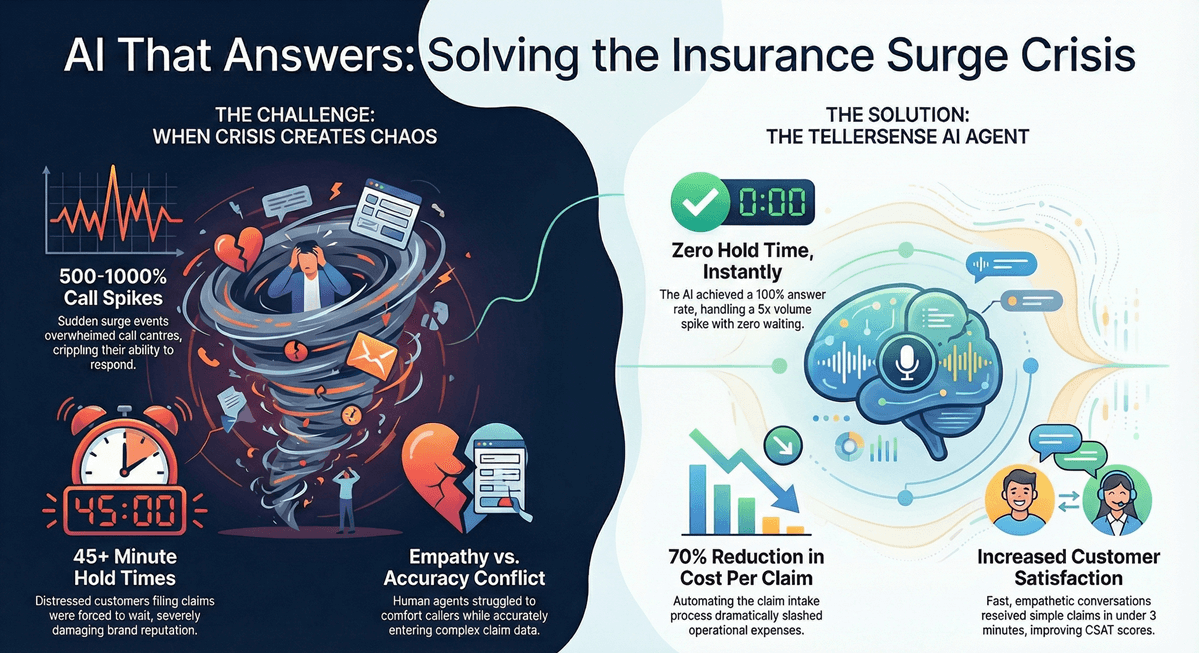
  • The “Surge” Crisis: During peak seasons, call volumes spiked by 500-1000%. Customers filing accident claims faced hold times exceeding 45 minutes. This friction led to high customer churn and severely damaged the brand’s reputation during the exact moments customers needed them most.

  • Unsustainable Staffing Costs: Staffing a 24/7 call center to handle theoretical peaks is financially impossible. Relying on temporary BPO staff often resulted in lower quality service and data entry errors due to a lack of training.

  • The Empathy vs. Data Conflict: Human agents struggled to balance “soft skills” (comforting a distressed caller) with “hard skills” (accurately typing complex accident details into legacy fields). This often led to incomplete claim files that required expensive follow-up calls to rectify.

In the insurance business, a 45-minute hold time isn't just an annoyance; it's a broken promise. We built TellerSense to ensure that help is always just one ring away, regardless of storm volume or time of day.

AI Voice Agent Developer, The AI Division
TellerSense AI Voice Agent The AI Division Infographic

The Solution

The AI Division architected a Low-Latency Voice Ecosystem that prioritizes speed and integration. We didn’t just build a chatbot; we built a virtual agent that lives inside the telephony network.


The Workflow Breakdown

  • The Latency Engine (The Speed):
    To eliminate the awkward “robot pause” typical of AI, we optimized the pipeline using Groq inference engines. This achieved a voice-to-voice latency of under 500ms. The result is a fluid conversation where the AI responds as quickly as a human, maintaining the illusion of presence.
  • Conversational Flow Manager (The Listener):The agent is trained on thousands of historical claim scenarios. Crucially, it supports “Barge-In” interruptions. If a user cuts the bot off to correct a detail (e.g., “No, it was the left bumper, not the right”), the bot stops speaking immediately, processes the correction, and continues. This mimics natural human dialogue patterns.
  • Real-Time Data Injection (The Scribe): As the user speaks, TellerSense performs background tasks. It extracts structured entities (Date of Incident, Location, License Plate) and injects them directly into the client’s SQL database via API in real-time. By the time the call hangs up, the claim is already filed.
  • Sentiment Guardrails (The Empath): The model analyzes the user’s vocal pitch and speed. If it detects anger or distress, the AI shifts its prompt engineering to be more apologetic, slower-paced, and reassuring, ensuring the customer feels supported rather than processed.

Technology Stack

We utilized a bleeding-edge voice stack designed for speed and reliability:

  • Telephony Infrastructure: Vapi.ai / Twilio (For handling the SIP trunking and call routing).

  • Speech-to-Text (STT): Deepgram Nova-2 (Chosen for its high accuracy with accents and background noise).

  • Text-to-Speech (TTS): ElevenLabs Turbo (For hyper-realistic, low-latency voice synthesis).

  • Inference Engine: Groq (LPU architecture for ultra-fast token generation).

  • Backend Logic: Node.js (Handling the API integrations with the legacy CRM).

The Results

TellerSense fundamentally solved the “Scalability vs. Quality” trilemma for the client:

  • Zero Hold Time: The system achieved a 100% answer rate immediately, even during a 5x volume spike caused by regional flooding. Every customer was greeted instantly.

  • 70% Cost Reduction Per Claim: By automating the intake process, the cost-per-claim dropped significantly compared to human-agent rates.

  • Higher CSAT Scores: Customer Satisfaction actually increased because simple claims were resolved in under 3 minutes without the frustration of hold music or transfers.

Answer Rate
0 %
Cost Reduction
0 %